




The global market for artificial intelligence (AI)-enabled healthcare is projected to grow from US$15 billion in 2023 to approximately US$188 billion by 2030, President and Chairman of the Board of Directors of the ECOWAS Bank for Investment and Development (EBID), Dr George Agyekum Donkor, has revealed.
According to him, the broader global digital health market is also expected to surpass US$900 billion by 2030, underscoring the rapid transformation taking place in healthcare through technology.
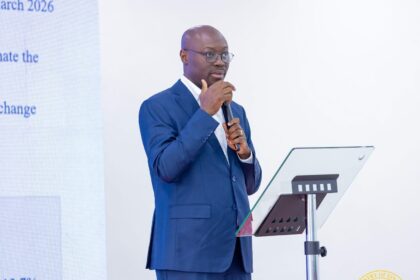
Dr Donkor made the remarks while delivering the keynote address at the International Conference on AI in Healthcare and Pharma (ICAIH), hosted by the University of Health and Allied Sciences (UHAS).
The three-day conference is being held under the theme, “Transforming Healthcare from Expenders to Healthpreneurs: Leveraging AI as the Bedrock for Regional Cooperation.”
He called for a rethinking of Africa’s healthcare systems, urging governments and stakeholders to embrace AI-powered diagnostics, medical research, pharmaceutical manufacturing and innovative healthcare enterprises capable of serving the continent’s growing population.
Dr Donkor noted that although the West African Development Outlook (WADO) projects economic growth of 4.8 percent for the ECOWAS sub-region in 2025, productivity remains relatively low, with nearly six million people expected to be unemployed by the end of 2026.
He added that health systems across the region continue to struggle with increasing patient demand, rising cases of chronic diseases and persistent shortages of skilled healthcare professionals.
Citing the World Health Organization (WHO), he said the world is expected to face a shortage of about 11 million health workers by 2030, with Africa likely to experience some of the greatest challenges.
Despite these concerns, Dr Donkor stressed that artificial intelligence should be viewed as a tool to support healthcare workers rather than replace them.
“Artificial Intelligence is not here to replace healthcare professionals, rather, it is a critical tool for extending AI reach and enabling better care with limited resources,” he said.
He noted that AI is already transforming healthcare by improving disease prevention, diagnosis, treatment, logistics, pharmaceutical research, hospital administration and public health surveillance.
Vice-Chancellor of UHAS, Professor Lydia Aziato, also called for stronger collaboration between universities, industry players and development partners to integrate AI into health education, research and healthcare delivery.
She said the university remains committed to producing graduates equipped with AI and digital skills to meet the evolving needs of the global healthcare industry.
Lead organiser of the conference and lecturer at the Institute of Health Research (IHR), UHAS, Professor Alexander Ansah Manu, described AI as an inevitable technological advancement that Ghana must embrace responsibly to improve healthcare delivery.
He emphasised that while AI relies on data, algorithms and statistics, healthcare must continue to prioritise compassion, ethics and professional judgment.
The conference is being held under the broader theme, “Accelerating Adoption of Healthcare AI in Ghana: From Vision and Policy to Practice and Impact,” with support from organisations including the WHO, UNESCO, UNICEF, HEFRA, the FDA, the University of Ghana Business School, Komfo Anokye Teaching Hospital, the Ministry of Health, Microsoft, the African Union, EBID and Africa CDC.