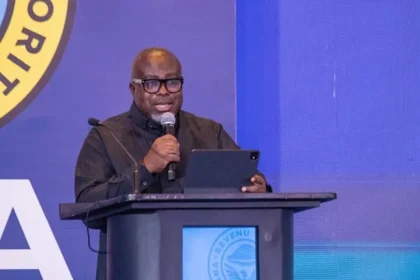




The Chief Executive Officer of the National Food Buffer Stock Company, George Abradu-Otoo, has revealed that Ghana requires at least GH¢1.5 billion to establish a robust national food reserve system capable of supporting farmers and stabilising food markets.
According to him, the GH¢300 million currently available to the company falls significantly short of what is needed to effectively purchase and store surplus grains during bumper harvest seasons.
Speaking in an interview on JoyNews on Thursday, June 18, 2026, Abradu-Otoo explained that while the government has made progress in supporting the company’s operations, the current level of funding is inadequate to achieve the desired impact.
“Last year, Minister of Finance Ato Forson announced that they were giving us a further GH¢200 million to continue the good work that we were doing, so in other words, so far we had only GH¢300 million,” he said.
He noted that the additional resources have enabled the company to begin building food reserves but stressed that much more investment is required to make the programme truly effective.
“If we need to do proper meaningful mopping up of excess grains, we need no less than GH¢1.5 billion, so you can imagine what GH¢300 million has done,” he stated.
Abradu-Otoo described the government’s decision to prioritise the establishment of strategic food reserves as a major step in the right direction.
“It’s a good beginning for the government to even think in the first place that we need to have a national food reserve,” he said.
He expressed concern that Ghana has fallen behind other countries in the West African sub-region in developing food reserve systems despite its strong agricultural potential.
“Because if you take the West African sub-region, Ghana is the only country that did not have a food reserve, can you believe that?” he remarked.
He further pointed out that even countries facing significant economic and security challenges have succeeded in establishing national food reserves.
“Interestingly, we can also have Mali have a national food reserve,” he added.
The Buffer Stock CEO’s comments come amid growing concerns over food security, post-harvest losses and the need for stronger government interventions to support farmers, stabilise grain prices and ensure food availability during periods of shortage.
Experts have long argued that a well-funded food reserve system could help reduce waste, improve food security and cushion consumers against sudden spikes in food prices.