



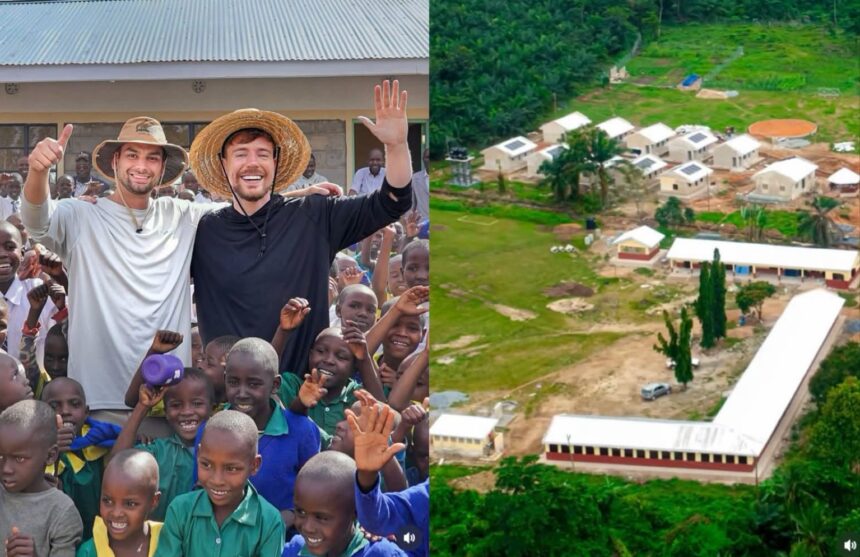
A school for more than 300 children, free homes for teachers, clean water systems, renewable energy, healthcare facilities and agricultural infrastructure are among the features of a new community built in Ghana by YouTube star Jimmy Donaldson, popularly known as MrBeast.
The project, which MrBeast describes as his most ambitious philanthropic initiative so far, has been valued at nearly $10 million and was developed over several months as part of an effort to tackle poverty and child labour in one of West Africa’s cocoa-growing communities.
Named Abna Dakwa Village, the community was built on previously undeveloped land with the aim of giving children in the area better access to education, healthcare, food and other basic services.
The project forms part of MrBeast’s wider 1 Billion Acts of Kindness campaign, a global initiative launched in January 2026 to encourage creators and their audiences to support charitable causes.
As part of the campaign, 20 content creators were selected to work with MrBeast on a major project in Ghana.
“We are going to Ghana. There is this village that desperately needs help. We will go there, build a hospital, wells, supply them with water and education,” he said at the launch.
Eight months later, MrBeast released a video on his YouTube channel on September 19, 2026, documenting how the project was built and the facilities that were created.
The development began with a modern school designed to accommodate more than 300 children.
Ten fully furnished homes were also constructed near the school to provide accommodation for teachers. The arrangement is intended to help attract and retain qualified educators in the community.
The project also included two large water towers and an off-grid solar power system, allowing the community to access clean water and generate electricity independently.
A bridge connecting the community to the school was renovated as well. The improvement is expected to make the journey to school safer for children, particularly by reducing the risk associated with crossing waterways.
Healthcare was another major part of the development.
A dedicated medical clinic was constructed and staffed to provide healthcare services to residents, while a central marketplace was established to support local businesses and trading activities.
MrBeast’s team also invested in agriculture and food production. Agricultural facilities and commercial fish tanks were added to help provide food for residents while creating opportunities for local income generation.
An upgraded washroom facility was also constructed as part of the project’s sanitation infrastructure.
Beyond building the facilities, the initiative included measures aimed at keeping children in school.
MrBeast partnered with philanthropic organisations, including The Rockefeller Foundation, to provide free daily meals to students for the next five years.
The project is particularly significant because of Ghana’s role in the global cocoa industry.
MrBeast owns Feastables, a popular chocolate brand that sources some of its cocoa from Ghana.
Cocoa-growing communities in Ghana and other West African countries continue to face economic challenges, with poverty among the factors linked to children becoming involved in cocoa farming rather than remaining in school.
The Abna Dakwa project is therefore designed to address some of the pressures facing families by providing education, healthcare, food, housing and improved economic infrastructure within the community.
The development involved more than a year of planning and brought together several international partners, including the 1 Billion Followers Summit, the Varkey Foundation and the Global Energy Alliance for People and Planet.
Ten content creators from different parts of the world also travelled to Ghana to participate in the project alongside construction workers and members of the local community. Ghanaian YouTuber Wode Maya was among those involved.
The project has attracted widespread attention online, with many viewers praising the scale of the investment and the facilities provided to the community.
However, the project has also sparked a broader conversation in Ghana about public spending and development priorities.
Some social media users have contrasted the nearly $10 million cost of the project with the large sums governments sometimes spend on public projects, arguing that investments should produce tangible benefits for ordinary citizens.
For many of those reactions, MrBeast’s project has become more than a philanthropic initiative. It has also prompted discussions about how investment in education, healthcare, water, energy and local economic opportunities can directly affect communities.
With the school, healthcare centre, housing, water infrastructure, renewable energy system and agricultural facilities now in place, Abna Dakwa Village represents an attempt to create a community where children can remain in school while families gain access to essential services and opportunities closer to home.