



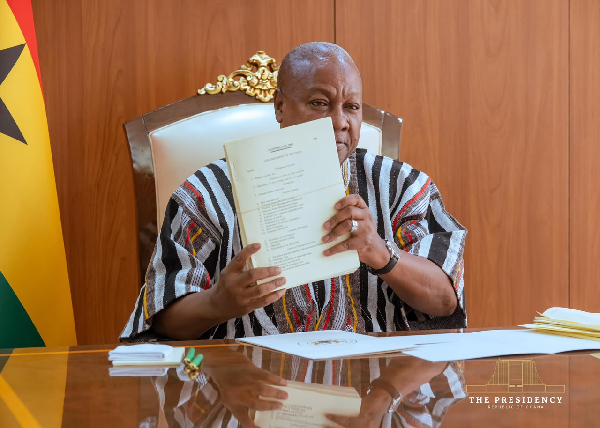
President John Dramani Mahama has signed 10 major bills into law, introducing a broad set of reforms covering taxation, cocoa production, revenue mobilisation, justice delivery, maritime security, education and social protection.
The new laws are intended to support economic growth, close revenue leakages, ease tax pressures on low-income workers, improve the justice system and strengthen Ghana’s regulatory framework across several sectors.
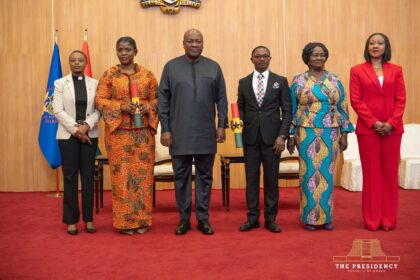
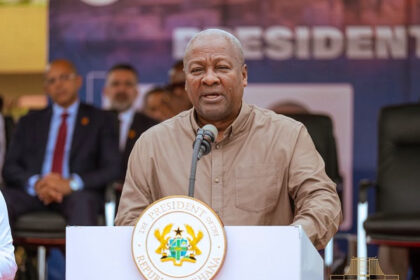
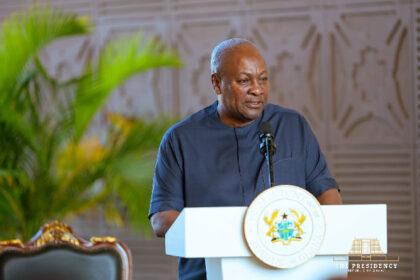
After signing the legislation, Mahama, accompanied by Chief of Staff Julius Debrah and other ministers, said the move fulfils key commitments made by his administration and provides a stronger legal basis for its development agenda.
One of the major enactments is the Ghana Cocoa Board Act, 2026, which contains reforms aimed at improving returns to cocoa farmers and increasing local processing of cocoa beans.
“I’m sure our cocoa farmers will be happy,” Mahama said.
He explained that the law incorporates the government’s commitment to process at least 50 percent of Ghana’s cocoa locally, while also targeting a return of 70 percent of the world market price for farmers.
“So, promise made, promise fulfilled,” he added.
The President also signed the Income Tax Amendment Act, 2026, which exempts workers earning the national minimum wage or below from paying income tax.
“This act exempts people who earn the minimum wage and below from paying income tax. Anybody who is on the minimum wage or below the minimum wage is exempt,” he said.
The Excise Act, 2026, is another major component of the package. It consolidates excise duties, seeks to reduce revenue losses on imported products such as alcohol and cigarettes, and introduces targeted exemptions for some local manufacturers.
Mahama said producers of locally manufactured fruit juice, in particular, would benefit from an exemption from excise duty.
“It is supposed to give them an incentive in their production. If you produce fruit juices locally, this act exempts you from paying excise duty,” he explained.
The government has also enacted new measures to strengthen fiscal administration through the Customs Act, 2026, the Energy Sector Levies Amendment Act, 2026, and the Value Added Tax (VAT) Amendment Act, 2026.
The Customs Act consolidates existing customs legislation into one statute, with Mahama saying the move will simplify administration and help address loopholes that have contributed to revenue losses.
“This voluminous document incorporates all the amendments that have been done over the years into one single document. It makes it simpler to administer and to make it more efficient. And it will seal the loopholes that have made the government lose a lot of revenue as a result of the scattered nature of the law,” he said.
The Energy Sector Levies Amendment Act seeks to end what the government describes as abuses of fuel oil exemptions by factories and maritime operators. Under the new arrangement, beneficiaries will pay the relevant taxes upfront and provide evidence before seeking reimbursement.
The VAT Amendment Act also makes changes to VAT administration. Among its provisions is an exemption from VAT for quantities of gold surrendered by large-scale mining companies to the Bank of Ghana, under the applicable arrangement.
The legislative package further introduces changes to Ghana’s justice and penal systems.
Under the Community Service Act, 2026, courts will be able to impose non-custodial sentences for certain minor offences, an approach the President said could reduce pressure on prisons and lower the cost of maintaining inmates.
“Instead of putting people in jail and government going to have to pay for looking after prisoners for stealing goods or for committing some very minor offences, they can be sentenced to do community service for the periods that they are convicted for,” Mahama said.
The Tribunals Act, 2026, also gives effect to constitutional provisions allowing the Chief Justice to establish Regional Tribunals to deal with specified categories of offences.
Another new law, the Maritime and Related Offences Act, 2026, domesticates provisions of the United Nations Convention on the Law of the Sea and provides a legal framework for prosecuting offences committed within Ghana’s territorial waters.
The final legislation in the package is the National Defence University Act, 2026, which gives the recently established military institution a formal statutory basis and enables it to offer accredited academic and strategic military programmes.
Together, the 10 laws represent a significant legislative push by the Mahama administration, covering economic, social, judicial and national security priorities.