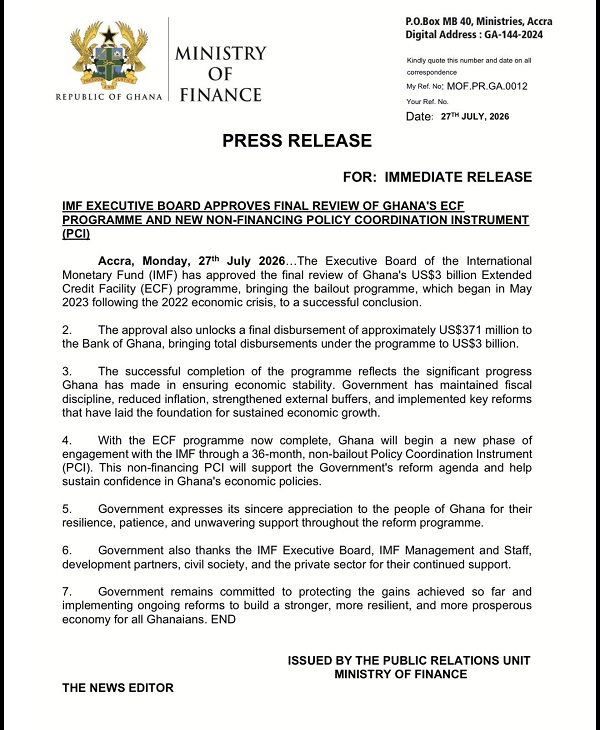




The Executive Board of the International Monetary Fund (IMF) has approved the final review of Ghana’s $3 billion Extended Credit Facility (ECF) programme, marking the successful completion of the country’s three-year economic support arrangement.
The approval, announced by the Ministry of Finance on Monday, July 27, 2026, unlocks a final disbursement of approximately $371 million to the Bank of Ghana, bringing the total amount released under the programme to about $3 billion.
The ECF programme, which began in May 2023 after Ghana’s 2022 economic crisis, was introduced to restore macroeconomic stability, support fiscal reforms and help the country address its debt challenges.
In a statement, the Ministry of Finance said the successful completion of the programme reflects the significant progress Ghana has made in stabilising the economy.
According to the ministry, the government maintained fiscal discipline, reduced inflation, strengthened external reserves and implemented key structural reforms that have laid the foundation for sustainable economic growth.
“The successful completion of the programme reflects the significant progress Ghana has made in ensuring economic stability,” the ministry stated.
With the ECF programme now concluded, Ghana will transition to a new phase of engagement with the IMF under a 36-month Policy Coordination Instrument (PCI).
Unlike the ECF, the PCI does not provide direct financial assistance. Instead, it is designed to support the government’s reform agenda, strengthen economic management and sustain investor confidence through continued policy coordination.
“With the ECF programme now complete, Ghana will begin a new phase of engagement with the IMF through a 36-month, non-bailout Policy Coordination Instrument (PCI),” the ministry said.
It added that the non-financing arrangement would help the government consolidate the gains made under the ECF while advancing key fiscal and structural reforms.
The Ministry of Finance expressed appreciation to Ghanaians for their resilience, patience and support throughout the implementation of the IMF-backed programme.
It also thanked the IMF Executive Board, management and staff, development partners, civil society organisations and the private sector for their contributions to the programme’s success.
Government reaffirmed its commitment to safeguarding the economic gains achieved under the ECF while pursuing reforms aimed at strengthening the economy, promoting stability and supporting long-term, inclusive growth.