



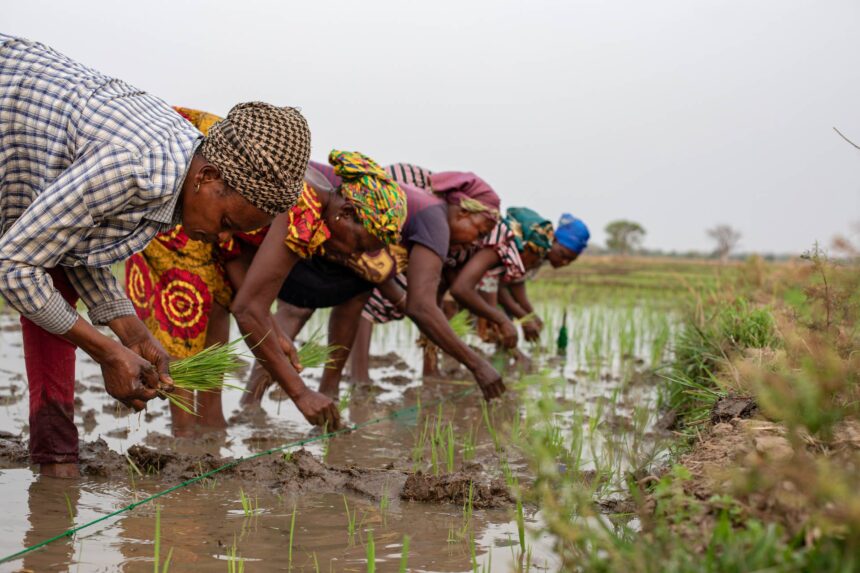
Thousands of rice farmers across Ghana’s major food-producing regions are scaling back or abandoning cultivation for the 2026 season as more than 700,000 metric tonnes of unsold rice remain locked up in warehouses and homes.
The situation has left many farmers without the funds needed to prepare their fields, hire machinery, or purchase inputs for the new planting season.
Speaking in an interview with the Business and Financial Times (B&FT), former Peasant Farmers Association of Ghana (PFAG) director Dr Charles Nyaaba said large portions of rice-growing valleys in the Northern, Volta and Oti regions have been left idle despite the start of the planting season.
“The valleys are virtually empty. Under normal circumstances, you would have seen tractors everywhere ploughing,” he said.
According to him, farmers are struggling with huge stocks of unsold rice from last year’s harvest, making it difficult to invest in a new production cycle.
“Their homes and warehouses are full of paddy rice. They owe combine harvester operators; others bought paddy rice on credit and haven’t paid. They told me it doesn’t make sense to continue farming when what they have produced is yet to be sold,” he explained.
Although government had previously indicated plans to purchase excess grain, farmers say little progress has been made on the ground.
Dr Nyaaba estimated that less than 20 percent of last season’s harvest of over 960,000 metric tonnes has been sold.
“I can confidently say that less than 20 percent have been able to secure a market. So we are still looking at over 700,000 metric tonnes of paddy rice in the warehouses and rooms of farmers, yet to be sold,” he said.
As a result, many farmers are planning to reduce cultivation significantly this year.
Dr Nyaaba disclosed that he intends to farm only half of his usual acreage, adding that many producers across the country are making similar decisions.
“Less than 50 percent of rice valleys will be farmed this year compared to last year,” he stated.
The development has raised concerns among economists and agricultural experts, who warn that reduced production could increase Ghana’s dependence on imported rice and place additional pressure on the economy.
Professor Abdullah Mumuni, Head of the Economics Department at the University of Professional Studies, Accra (UPSA), said lower production would affect employment, food availability and economic growth.
“If they are going to reduce production, it will affect employment; it will also affect food production and that will have influence on our GDP,” he noted.
Ghana currently imports about 70 percent of the rice consumed domestically, spending hundreds of millions of dollars annually on imports from countries including Thailand, Vietnam and India.
Experts say if the estimated 700,000 metric tonnes of unsold paddy rice were processed, it could yield roughly 350,000 metric tonnes of milled rice for local consumption, significantly reducing the country’s import requirements.
Professor Mumuni has therefore called for the introduction of a quota system to regulate rice imports and encourage the consumption of locally produced rice.
At the same time, he urged local producers to improve quality standards to make domestic rice more competitive.
Agricultural economist Professor Joshua Yindenaba Abor also warned that prolonged market challenges could worsen poverty levels in farming communities.
“If the glut we’re experiencing is without off-taking, then what it means is that they will suffer some financial losses. And that will impede the ability to also afford some basic needs,” he said.
He called on government agencies such as the National Food Buffer Stock Company (NAFCO) and the Ghana Commodity Exchange (GCX) to aggressively purchase excess grain while ensuring that state institutions prioritise locally produced food.
Farmers have also expressed frustration that a presidential directive requiring schools to procure food from local farmers has not been fully implemented, alleging that some institutions continue to stock imported rice.
Industry stakeholders are now urging government to accelerate support under the Feed Ghana programme, expand agro-processing capacity in farming communities, and strengthen measures to protect local producers from unfair competition from imported products.
Without urgent intervention, experts warn that Ghana could face lower rice production, rising food imports, pressure on the cedi and increased food insecurity in the coming years.