



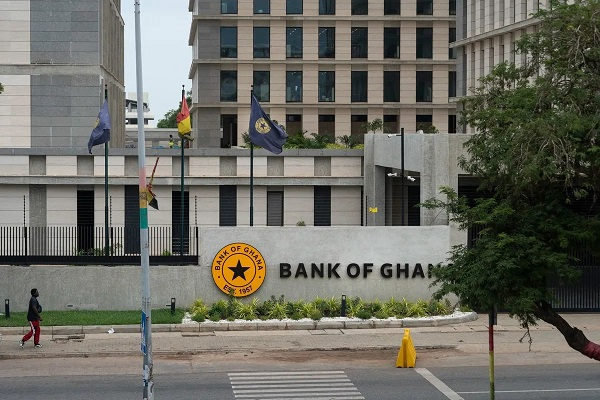
Ghana’s reported US$1.7 billion cost from the Bank of Ghana’s Domestic Gold Purchase Programme should not be viewed simply as an ordinary commercial trading loss, according to a new report.
The report argues that the more important question is whether the programme delivered enough economic and macroeconomic benefits to justify the cost.
On that basis, there is a strong case that the programme was worthwhile, particularly because it helped generate significant foreign-exchange resources, strengthen Ghana’s reserves and ease pressure on the cedi.
The International Monetary Fund has estimated that the expansion of the programme in 2025 resulted in losses of more than US$1.7 billion, equivalent to about 1.5 percent of Ghana’s gross domestic product.
However, the programme also played a major role in mobilising foreign exchange.
GoldBod says its gold purchases and exports generated more than US$10.8 billion in foreign exchange, with approximately US$10.6 billion subsequently intermediated into the domestic market.
During the same period, Ghana’s international reserves increased from US$8.9 billion in 2024 to around US$13.8 billion by December 2025, while the cedi appreciated by more than 41 percent.
These developments, the report argues, should be taken into account when assessing the programme.
A central bank’s primary responsibility is not to make profits from trading activities but to maintain monetary and financial stability. Therefore, if the acquisition of domestic gold helped increase foreign-exchange liquidity, build reserves, stabilise the currency and contribute to a sharp decline in inflation, the financial cost cannot be assessed in isolation.
The report also cautions against taking the US$1.7 billion figure at face value as a direct measure of wealth destroyed.
The Institute of Economic Affairs has argued that about 90 percent of the reported amount largely reflects exchange-rate valuation differences rather than an equivalent loss of national wealth.
GoldBod has similarly maintained that it operated as an agent for the Bank of Ghana in the gold purchase programme. As a result, the reported cost should not simply be characterised as a trading loss incurred by GoldBod.
Despite these arguments, the report agrees that the cost should no longer remain solely on the Bank of Ghana’s balance sheet.
It describes the programme as a fiscal policy intervention carried out through a monetary institution. Where government directs the state to purchase gold to achieve broader national objectives, including reserve accumulation, currency stabilisation, formalising the gold trade and reducing smuggling, the associated quasi-fiscal costs should ultimately be borne by the state.
Keeping such costs on the central bank’s books could weaken its financial position and limit its ability to carry out its core monetary responsibilities independently.
The report therefore recommends a clearer division of responsibilities going forward.
GoldBod should operate on a commercial basis, while government should explicitly budget for any strategic subsidies or stabilisation measures it wants to pursue. The Bank of Ghana, meanwhile, should remain focused on monetary policy, reserve management and supervision of the banking system.
The report concludes that Ghana should neither dismiss nor romanticise the US$1.7 billion cost.
If the programme helped prevent a much more damaging currency and inflation crisis, then the expenditure could reasonably be regarded as a worthwhile national investment. However, the cost should also be made visible and properly accounted for.
Future costs associated with such interventions, it argues, should be transparently included in the national budget so that Parliament and taxpayers can scrutinise and debate them.
That approach, the report says, would not only improve accounting but also strengthen economic governance and ensure that the financial consequences of government policy are carried by the institution ultimately responsible for those decisions.