



A growing number of working Ghanaians are approaching retirement with little confidence in their financial preparedness, according to the 2025 Old Mutual Financial Wellness Monitor.
The survey found that nearly three out of every four employed Ghanaians believe they have not saved enough for life after work, continuing a worrying trend that has persisted over the last three years.
The annual study surveyed 656 employed people between the ages of 20 and 59 who earn at least GH¢1,200 monthly. Conducted in October 2025, the survey reflected a workforce made up of both formal and informal sector workers.
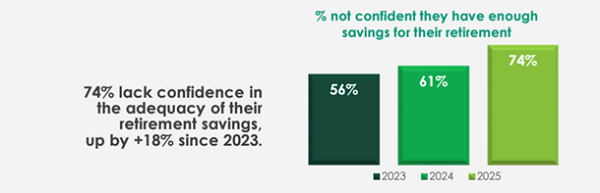
According to the findings, 74 percent of respondents said they lacked confidence in the adequacy of their retirement savings, an increase from 61 percent in 2024 and 56 percent in 2023.
Despite growing awareness about the importance of retirement planning, only one in three respondents said they had actively started saving toward retirement.
The report highlighted a widening gap between what people know and what they are practically able to do financially.
While 92 percent agreed that saving for retirement is important, retirement savings ranked only seventh among people’s financial priorities, trailing behind emergency funds, children’s education and business development.
Financial pressure remains the biggest obstacle for many workers. About 32 percent of respondents who were not saving for retirement said immediate household expenses and short-term financial demands consumed most of their income.
Another 55 percent indicated they expected their children to support them financially in old age.
The survey also pointed to lingering distrust in formal financial institutions following Ghana’s financial sector crisis between 2017 and 2020, as well as the impact of the Domestic Debt Exchange Programme.
More than half of respondents who were not actively saving for retirement said they feared losing their money if pension providers collapsed.
The retirement concerns extended across all income levels, including higher earners. Among workers earning GH¢3,001 and above, 66 percent still expressed little confidence in their retirement plans.
Across all respondents, the average confidence score regarding retirement preparedness stood at 4.9 out of 10.
The report further showed that only 13 percent of respondents use financial advisers, while nearly half admitted they did not know where to seek proper financial guidance.
Although the findings revealed major retirement concerns, the survey also captured signs of broader economic recovery.
The proportion of workers experiencing high financial stress reportedly fell from 60 percent in 2024 to 30 percent in 2025, while confidence in the economy rose significantly over the same period.
Thirty-seven percent of respondents said they now earn more than they did a year earlier, while debt levels and dependence on borrowing have also reduced for many households.
However, financial vulnerability remains widespread. More than half of respondents said they would run out of funds within three months if they lost their income source, while 39 percent still feared losing their jobs or businesses.
The study also found that savings habits remain largely informal and short-term, with many respondents relying on bank accounts, mobile money and susu schemes rather than long-term investment products.
Commenting on the findings, Old Mutual Ghana Group Chief Executive Roy Punungwe said the survey showed that although economic conditions are improving, many Ghanaians remain financially exposed.
“While people are saving more and managing debt better, the data tells us clearly that most Ghanaians remain financially vulnerable,” he said.
He stressed that retirement planning and long-term financial security must become a greater priority for both households and financial institutions.
“What this Monitor reinforces is that financial wellness is not only about getting through the next six months, it is about preparing for the next 20 to 30 years,” Punungwe added.