



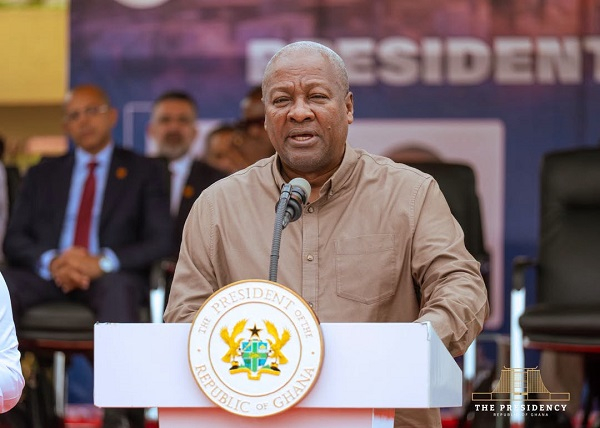
President John Dramani Mahama has directed the Media Foundation for West Africa (MFWA) and the Ghana Journalists Association (GJA) to lead a national stakeholder engagement on hate speech, abusive language and other harmful content on social media and emerging digital platforms.
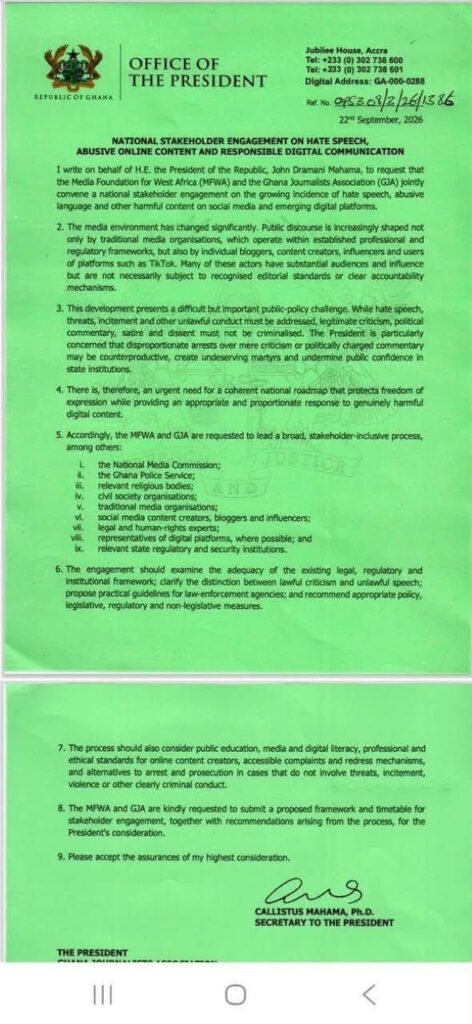
The directive was contained in a letter dated September 22, 2026, and signed by the Secretary to the President, Callistus Mahama, on behalf of the President.
The planned engagement is expected to bring together media organisations, state institutions, civil society groups, digital content creators and other stakeholders to examine growing concerns over online content while safeguarding freedom of expression.
The Presidency said Ghana’s media environment has changed considerably, with public discussions increasingly taking place outside traditional media organisations.
“Public discourse is increasingly shaped not only by traditional media organisations, which operate within established professional and regulatory frameworks, but also by individual bloggers, content creators, influencers and users of platforms such as TikTok,” the letter stated.
It noted that many of these individuals and groups command large audiences and wield significant influence but may not operate under recognised editorial standards or established accountability mechanisms.
According to the President, the changing media landscape presents a public-policy challenge that requires careful consideration.
The letter emphasised that hate speech, threats, incitement and other unlawful conduct must be addressed, while warning against measures that could unnecessarily restrict legitimate criticism and public debate.
“The President is particularly concerned that disproportionate arrests over mere criticism or politically charged commentary may be counterproductive, create undeserving martyrs, and undermine public confidence in state institutions,” the statement said.
The stakeholder engagement is therefore expected to explore ways of balancing freedom of expression with the need to respond to genuinely harmful digital content.
MFWA and the GJA have been asked to lead the process with participation from the National Media Commission, Ghana Police Service, religious bodies, civil society organisations, traditional media organisations, bloggers, influencers and other content creators.
Legal and human-rights experts, digital platforms and relevant regulatory and security institutions are also expected to participate.
Among the issues to be examined are existing legal and regulatory frameworks and the distinction between lawful criticism and speech that amounts to an offence.
The engagement is expected to produce practical guidelines for law-enforcement agencies and recommendations on policy, legislation, regulation and non-legislative measures.
The process will also consider public education, media and digital literacy, professional and ethical standards, accessible complaints and redress mechanisms, as well as alternatives to arrest and prosecution in cases that do not involve threats, incitement, violence or other clearly criminal conduct.
The MFWA and GJA have been tasked with submitting a proposed framework and timetable for the engagement, together with recommendations emerging from the process, for the President’s consideration.
See the letter below: