




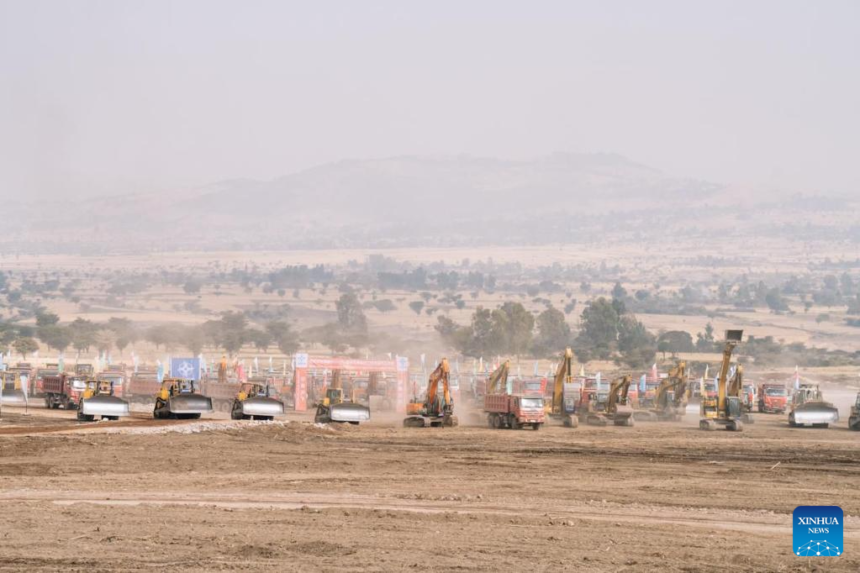
Ethiopia has officially commenced construction of the Bishoftu International Airport, a massive aviation project expected to become the largest airport in Africa when completed.
Prime Minister Abiy Ahmed launched the project on Saturday, laying the foundation stone at the site near Bishoftu town in the Oromia Regional State, about 40 kilometres southeast of Addis Ababa. He was joined by senior government officials and industry stakeholders at the ceremony.
Addressing the gathering, Prime Minister Abiy described the airport as a key component of Ethiopia’s long-term strategy to sustain rapid growth in the aviation sector and reinforce the country’s status as Africa’s leading air transport hub. He said the project symbolises Ethiopia’s drive toward modernization, economic prosperity and transformative development.
The Prime Minister disclosed that the airport will initially be designed to handle 60 million passengers annually within four years of the first phase’s completion. When fully developed, its capacity is expected to reach 110 million passengers per year. He noted that Addis Ababa Bole International Airport, which currently serves about 25 million passengers annually, is nearing its maximum capacity due to growing demand.
Group Chief Executive Officer of Ethiopian Airlines, Mesfin Tasew, outlined key features of the first phase of the project, including two large passenger terminals, two parallel runways, parking facilities for 180 aircraft, a hotel, a cargo terminal capable of handling 1.5 million tonnes of goods annually, and an aircraft maintenance facility.
He added that the project will also include a modern multi-lane highway linking the airport to Addis Ababa, as well as a 38-kilometre high-speed railway with operating speeds ranging between 120 and 200 kilometres per hour.
Upon completion, the Bishoftu International Airport is expected to significantly boost Ethiopian Airlines’ global competitiveness, improve connectivity across Africa under the African Continental Free Trade Area, promote trade and tourism, and position Ethiopia as a major intercontinental aviation hub.