



Israel is edging toward a major political crisis as lawmakers debate a controversial bill that would draft more ultra-Orthodox Jewish men into the military—an issue that has rapidly become one of the most volatile challenges facing Prime Minister Benjamin Netanyahu.
Public sentiment has shifted sharply after two years of war, transforming the long-running debate over Haredi military exemptions into a national flashpoint. The exemption, granted to ultra-Orthodox men engaged in full-time religious study since the founding of the state in 1948, was ruled illegal by Israel’s High Court nearly two decades ago. Temporary extensions remained in place until last year, when the court finally ordered the government to begin drafting the community.
Although around 24,000 draft notices were issued last year, military officials told lawmakers that only about 1,200 ultra-Orthodox men actually reported for service.
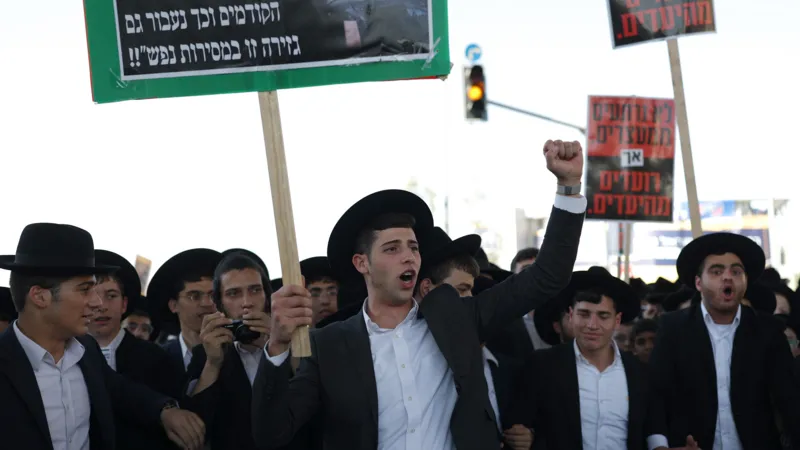
The dispute has now spilled into the streets. As parliament weighs a new bill to enforce conscription for Haredi men, tensions have escalated sharply. Two ultra-Orthodox politicians were recently targeted by extreme protesters outraged by the legislative push, and last week a special Border Police unit had to rescue Military Police officers surrounded by a large crowd while attempting to arrest a suspected draft evader.
In response, ultra-Orthodox activists have launched a rapid-alert system known as “Black Alert” to mobilize large groups quickly and prevent future arrests.
The proposed changes have already triggered massive demonstrations, including a protest in Jerusalem last month that drew tens of thousands of Haredi men. For many within the community, the conscription debate represents a wider struggle over the character of the Jewish state and the role of religion within it.
“We’re a Jewish country,” said protester Shmuel Orbach. “You can’t fight against Judaism in a Jewish country. It doesn’t work.”